andrey bogush
when everything is over so we can discuss
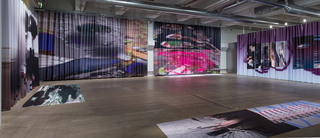
When Everything Is Over So We Can Discuss
The Finnish Museum of Photography, Helsinki
18.5.–14.8.2016
“There is some kind of digital nostalgia in the images, when working with digital tools. The image becomes filled with its own personal history. In Photoshop, the History Brush Tool restores all the things that I did to the image, at some specific moment of the image. This is enormously crucial to the process and for the final object.” - Andrey Bogush, 2016
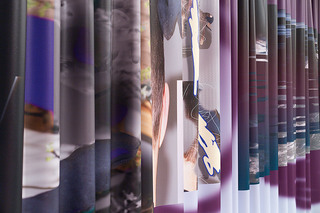
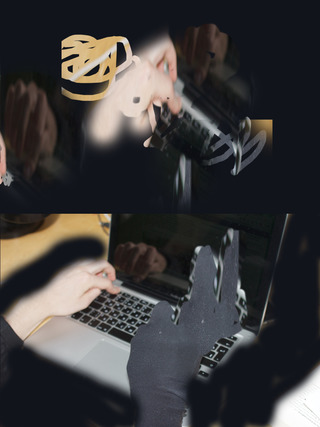
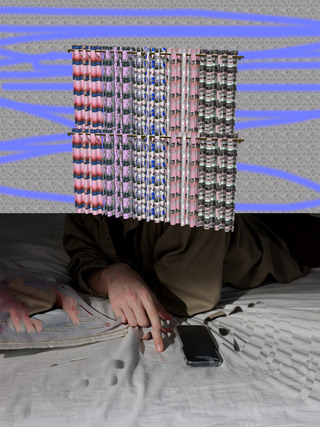
In Andrey Bogush's (born in 1987) photographic installations, the materiality of the photographs is part of both the digital and the physical space. Bogush records his own life by taking fragmentary diary snapshots. He processes the photographs using photo-editing software – adding elements and unnatural colours, and blurring decisive moments – which serves to disrupt the representational nature of the photographs. The photographs transform into images, with the original subject, time or geographic location becoming almost unidentifiable. The image produced by the camera and the image produced by the artist with the photo-editing software become intertwined.
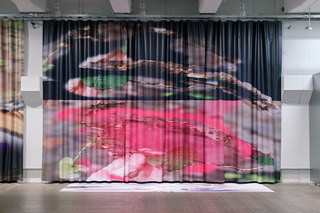
Bogush's work is sometimes called post-internet art, as Bogush uses Internet tools and digital methods to recreate things and surfaces that exist in the real world. The works give physical form to digital structures. Indeed, the material on which the images are printed and the physical space in which the viewer encounters them become an essential part of the art.
“There is a very physical connection between my eye and the object, and the computer screen also becomes part of my eye – it essentially touches the image all the time. Digital files are very material for me. The task is how to incorporate that materiality in the image,” says Bogush.
from press release, The Finnish Museum of Photography, 2016
https://www.valokuvataiteenmuseo.fi/en/exhibitions/when-everything-over-so-we-can-discuss
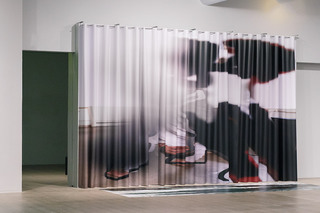
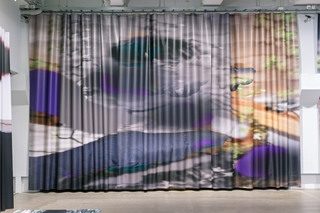
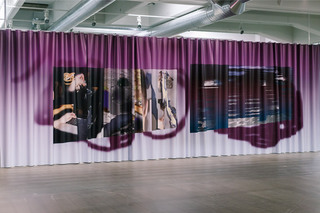
"Data to computer scientists is as concrete as atoms to nuclear physicists or DNA to biologists. Although generally considered in abstract terms, these elements function as the foundational building blocks of our perceptible world. Take digital images for example: What we see on screen are not apparitions but tangible visual information. From this standpoint, artist Andrey Bogush dissects digital photography as material that can be calculated, coded, and manipulated. For his exhibition “When Everything Is Over So We Can Discuss,” Bogush renders quotidian photographs—shot while working at home or in nature—with digital patterns and hazy swaths or scribbles of color. Pulling these images off the screen and into sculptural space, Bogush printed them on industrial vinyl and has hung them as rippled curtains lining the walls or as flat carpets on the floor. ...
Representing digital tools of production, smart phones and laptops are combined with plant matter that makes appearances throughout. At times, images are reconfigured and juxtaposed as floating screens cut and pasted at angles, then flattened onto gradient layers, collapsing the visual depth of the foreground and background. Life experienced daily on-screen bears equal weight to that captured in physical space, and as distinctions begin to blur, digital life for artists like Bogush has long become second nature.
from Andrey Bogush at Finnish Museum of Photography, by Arielle Bier, Artforum
https://www.artforum.com/events/finnish-museum-of-photography-222563/
JavaScript is turned off.
Please enable JavaScript to view this site properly.